

Serving Fashion Fast & Sustainably: How UNIQLO Aced It
How the Japanese apparel giant is building a long-term, locally rooted, and customer-first strategy for India.
By Vaishnavi Gupta, Associate Editor
Dec 19, 2025 / 19 MIN READ


When UNIQLO opened its first store at Ambience Mall, Vasant Kunj, New Delhi, in October 2019, it was more than just another retail launch — it marked the entry of one of the world’s most admired apparel brands into one of the most dynamic and fast-evolving fashion markets. Five years on, UNIQLO has quietly and steadily expanded its footprint across India, redefining what functional fashion means for Indian consumers.
For Kenji Inoue, COO & CFO, UNIQLO India, the brand’s journey in India is a marathon, not a sprint. “India is a long-term market for UNIQLO, and an important part of our global growth strategy. We see tremendous potential here to continue to grow along with the community. Simply put, we aim to become the No. 1 customer-trusted brand in India,” he said.
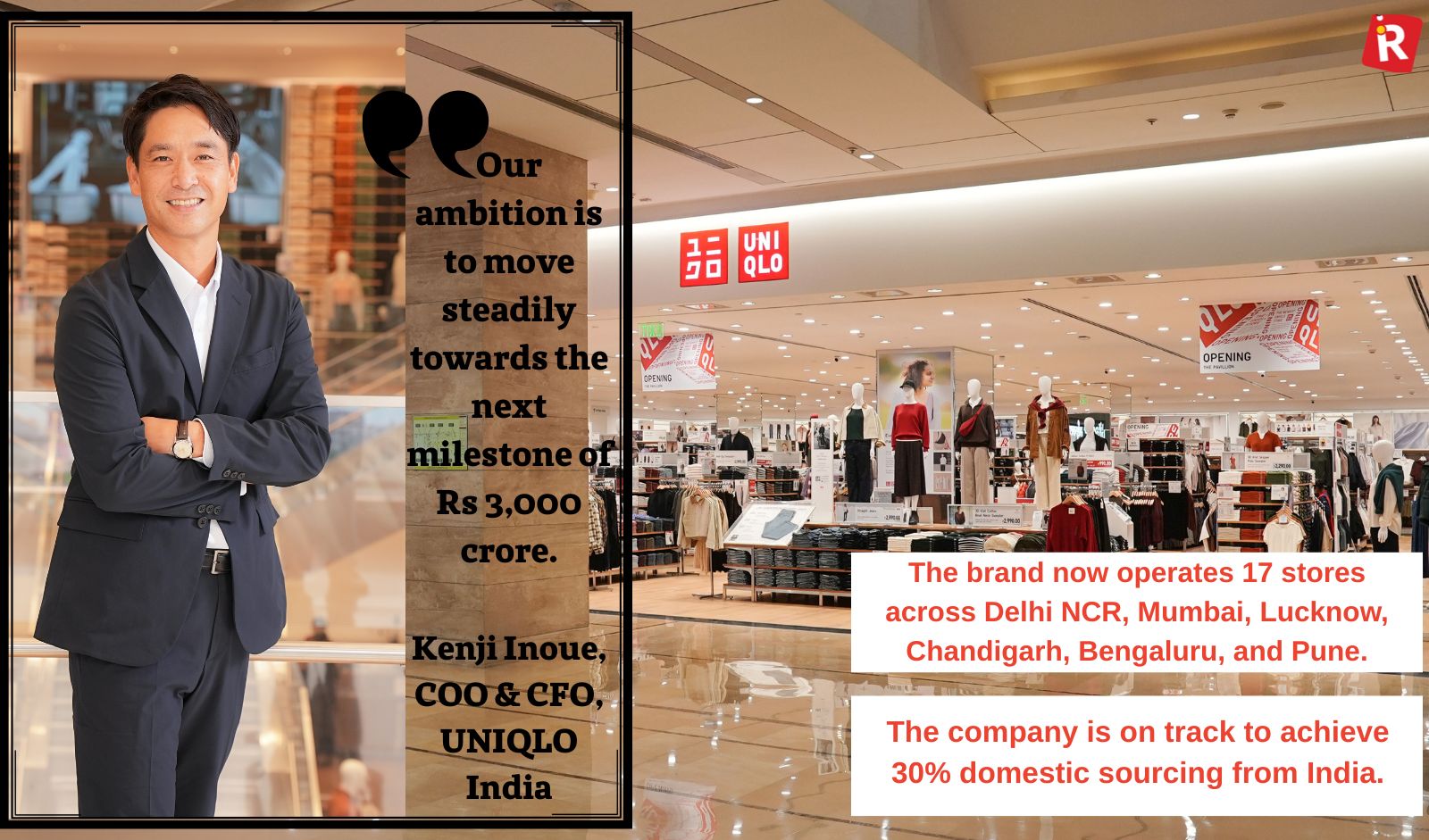
Today, UNIQLO operates 17 brick-and-mortar stores across key cities —Delhi NCR, Mumbai, Lucknow, Chandigarh, Bengaluru, and Pune — alongside a robust and growing e-commerce platform.
Building the Foundation
UNIQLO’s entry into India was strategically timed to tap into a growing consumer base that values quality, comfort, and design simplicity. Unlike fast-fashion players who focus on trends and rapid product cycles, UNIQLO’s philosophy — LifeWear — focuses on creating high-quality, timeless clothing designed to improve everyday life.
“Our focus remains on thoughtful expansion, prioritizing cities and regions that reflect the growing appetite for our functional, high-quality apparel,” Inoue explained. “As we continue to grow, we will strengthen both our offline and online channels to make UNIQLO’s LifeWear accessible to a wider audience across the country.”
The brand’s distribution strategy follows a balanced omnichannel model. While physical stores remain at the heart of customer experience, digital channels are an equally important growth engine. Currently, around 15 percent of UNIQLO India’s business comes from e-commerce, through its own website and mobile app.
At the same time, UNIQLO has consciously chosen not to sell through third-party marketplaces. As Inoue puts it, “We have made a conscious decision to stay focused on our own ecosystem — UNIQLO.com, our mobile app, and physical stores — because we want to fully own and elevate the customer experience. For us, these are not just sales channels but important touchpoints for customers to experience our values and discover the comfort and quality of LifeWear.
LifeWear for India: Global Values, Local Relevance
At the heart of UNIQLO’s success lies LifeWear — clothing that embodies simplicity, quality, and longevity. The brand’s appeal lies not in chasing trends, but in crafting garments that deliver lasting comfort and functionality. Yet, in India, that philosophy has been carefully localized.
“Our approach to product development is rooted in the LifeWear values of simplicity, quality, and functionality. We have found that these values resonate deeply with Indian customers,” Inoue says.
While UNIQLO’s global assortment remains consistent, its product mix in India is tailored to local preferences. Breathable, lightweight fabrics such as Linen and AIRism dominate the summer range, while HEATTECH and PUFFTECH collections see strong demand during winter months.
Indian consumers, Inoue noted, appreciate subtle tones, soft materials, and versatile silhouettes that transition easily between work and casual wear. “We consider local preferences in color, fabric, and fit. Indian customers have responded well to soft, breathable materials, subtle tones, and adaptable silhouettes. Looking ahead, we will continue to closely listen to our customers’ voices in order to ensure we are always meeting their needs.”
The brand’s seasonal and city-specific assortments also reflect its commitment to customer insight. For instance, stores in North India carry a wider winter assortment, while those in South India focus more on all-season comfort wear.
A Manufacturing Hub in the Making
Even before its retail debut, UNIQLO was already investing in India’s manufacturing ecosystem. Fast Retailing, its parent company, set up a production office in Bengaluru in 2016 to oversee local production and quality management. This early investment underscored the company’s belief in India’s potential as both a consumer and production powerhouse.
“We are now producing global standard goods in India, and are currently on track to achieve 30 percent domestic sourcing from India,” Inoue revealed. UNIQLO’s partnership with local manufacturers goes beyond procurement — it’s about capacity building.
Through the expertise of its Takumi, or “master craftsmen,” the company works closely with Indian factories to raise standards in quality and efficiency. These specialists help local partners adopt advanced techniques in textile production, ensuring that the output meets UNIQLO’s stringent global benchmarks. “By leveraging the expertise of our Material Experts, known as Takumi, we are currently engaged in localizing the production of our highly functional fabrics within India. The range of varieties produced domestically continues to expand season after season, with notable examples including AIRism and HEATTECH fabrics,” Inoue shared.
Collaborations that Connect Creativity and Culture
While UNIQLO’s product strategy centers on simplicity, its collaborations add excitement and creativity to the brand. From high-fashion designers to pop-culture icons, these partnerships bring new audiences into the LifeWear universe.
“Collaborations are an integral part of how UNIQLO brings new creativity and perspective to LifeWear,” stated Nidhi Rastogi, Marketing Director, UNIQLO India. “Our partnerships with global designers and cultural icons have helped us connect with a wide range of audiences while staying true to our values of simplicity, quality, and longevity.”
In India, customers have shown strong enthusiasm for global collaborations such as JW Anderson and Clare Waight Keller, as well as UT collections that feature global artists and brands. The upcoming Pop Mart UT and KAWS collaborations, launching during the Arigato Festival in November, are already generating excitement.
At the same time, UNIQLO has been localizing its creative initiatives. Its UTme! India Art Project invites emerging Indian artists to design exclusive T-shirts and tote bags inspired by India’s cultural energy. “Through this project, we created designs inspired by India’s creativity and cultural heritage. It helps us build a deeper local connection while supporting emerging talent,” Rastogi explained.
Marketing with Meaning
While UNIQLO’s product values are universal, its marketing approach in India is distinctly local. The brand adapts its storytelling to each city, celebrating regional culture, lifestyle, and individuality. “Localization plays a very important role in how we communicate about UNIQLO in India. While our global philosophy of LifeWear remains the same everywhere, our marketing approach is shaped by local insights and the unique characteristics of each city,” remarked Rastogi.
For instance, during the Bengaluru launch, UNIQLO created a campaign that reflected the city’s modern yet grounded spirit, featuring Rahul Dravid, whose calm confidence mirrored the brand’s ethos. Similarly, in Pune, UNIQLO collaborated with colleges and local influencers to reach a younger demographic.
The brand also uses technology to build interactivity — such as AR/VR installations that allow customers to engage with the brand in immersive ways. “We tailor-make every campaign based on the customers we are speaking to, ensuring that our communication feels relevant, authentic, and true to each city’s spirit,” Rastogi noted.
Innovation Through Product Excellence
With over 11,000 SKUs in India, its assortment covers every wardrobe need — from core LifeWear essentials to advanced technical fabrics.
This season, UNIQLO introduced its PUFFTECH jackets, known for their lightweight warmth, alongside HEATTECH Extra Warm Cashmere Blend — a 9 percent cashmere blend that combines luxury with comfort. These innovations reinforce UNIQLO’s belief that technology and fashion can co-exist to enhance daily life.
Crossing the Rs 1,000 Crore Milestone
UNIQLO India’s steady approach has paid off. The company recently crossed the Rs 1,000 crore revenue milestone in FY2025, reflecting healthy double-digit growth year on year. India now ranks among UNIQLO’s fastest-growing markets in Asia.
“India’s young demographic, growing focus on quality, and increasing appreciation for functional everyday clothing have all contributed to this progress,” Inoue said. “The next few years will be about strengthening customer engagement, solidifying store operations, and enhancing efficiency across channels. Our ambition is to move steadily towards the next milestone of Rs 3,000 crore while ensuring that every aspect of our growth remains true to UNIQLO’s LifeWear philosophy.”
The next phase of expansion will see the brand strengthening its presence in existing markets, enhancing operational efficiency, and expanding responsibly into new cities. “Our vision is to grow responsibly and contribute positively to India’s evolving retail landscape, while continuing to make LifeWear an integral part of everyone’s daily life,” Inoue concluded.
When UNIQLO opened its first store at Ambience Mall, Vasant Kunj, New Delhi, in October 2019, it was more than just another retail launch — it marked the entry of one of the world’s most admired apparel brands into one of the most dynamic and fast-evolving fashion markets. Five years on, UNIQLO has quietly and steadily expanded its footprint across India, redefining what functional fashion means for Indian consumers.
For Kenji Inoue, COO & CFO, UNIQLO India, the brand’s journey in India is a marathon, not a sprint. “India is a long-term market for UNIQLO, and an important part of our global growth strategy. We see tremendous potential here to continue to grow along with the community. Simply put, we aim to become the No. 1 customer-trusted brand in India,” he said.